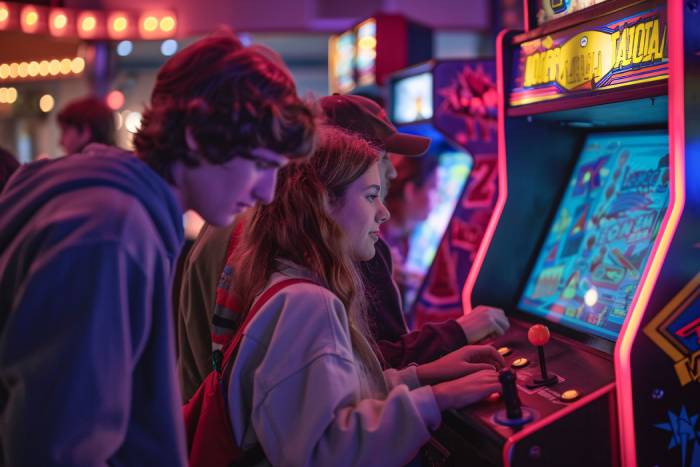
There is something uniquely powerful about the classic arcade cabinet. Standing alone in a darkened room, its screen blazing with colour, its soundtrack cutting through the ambient noise of a chip shop or bowling alley — the arcade machine was designed to demand attention. And for two decades, from roughly 1978 to the mid-1990s, it succeeded brilliantly.
The golden age of arcades produced a remarkable number of games that not only entertained millions of people but fundamentally shaped how video games are designed to this day. The mechanics invented in cramped developer offices in Japan and California still echo through the games we play on modern consoles and smartphones. This is the story of the machines that started it all.
Space Invaders (Taito, 1978)
It is almost impossible to overstate the cultural impact of Space Invaders. Designed by Tomohiro Nishikado, who built the hardware himself because no existing chip was fast enough for his vision, Space Invaders introduced the world to several conventions that we now take entirely for granted.
The game featured a persistent high score — displayed at the top of the screen and stored even after the machine was switched off. It rewarded repeat plays not just through competition but through the gradual experience of learning the patterns of the descending aliens. And crucially, it got faster as you killed more invaders — the challenge escalated dynamically based on player skill, a mechanic that remains fundamental to game design.
The game was so successful in Japan that it reportedly caused a shortage of 100-yen coins as the Bank of Japan struggled to keep up with demand. Atari's exclusive home rights for the Atari 2600 caused the console's sales to quadruple, establishing the model of arcade-to-home porting that would define gaming commerce for years.
Pac-Man (Namco, 1980)
Toru Iwatani wanted to make a game that women would enjoy. The arcades of the late 1970s were considered a male-dominated, vaguely intimidating environment. Iwatani's solution was deliberately non-violent — a character who ate rather than shot, navigated mazes rather than invaded aliens, and whose enemies had names and distinct personalities.
The four ghosts — Blinky, Pinky, Inky, and Clyde — were each programmed with different behaviours. Blinky chases Pac-Man directly; Pinky tries to ambush him from ahead; Inky behaves unpredictably; Clyde alternates between chasing and fleeing. This variety created genuinely complex emergent gameplay that players spent years analysing and mastering.
Pac-Man's cultural reach extended far beyond gaming. It was the first video game character to become a mainstream pop culture icon, appearing on merchandise, in advertising, and in media long before Mario or Sonic achieved similar status. The Saturday morning cartoon ran for two seasons in the US and attracted millions of young viewers. Buckner and Garcia's novelty song "Pac-Man Fever" reached number nine on the Billboard Hot 100 in 1982. It was, by any measure, a phenomenon.

Donkey Kong (Nintendo, 1981)
Before Mario was Mario, he was Jumpman — a stocky, moustachioed carpenter tasked with climbing construction scaffolding to rescue a woman from a giant ape. Donkey Kong was designed by Shigeru Miyamoto, working alongside technical director Gunpei Yokoi, and it introduced a form of platforming that had never been seen in arcades before.
Where most arcade games of the era involved moving in two dimensions and shooting, Donkey Kong asked players to navigate vertical space. Jumpman had to jump over rolling barrels, climb ladders, and time his movements carefully. The game featured multiple distinct stages with different challenges — again, something quite new at the time.
Nintendo's decision to export Donkey Kong to the United States transformed the company's fortunes. The game became one of the highest-earning arcade titles of 1981 and 1982, and the character of Jumpman — renamed Mario for the 1983 game Donkey Kong Jr. — went on to become the most recognisable video game character in the world.
Galaga (Namco, 1981)
A sequel to Galaxian, Galaga refined the fixed-shooter format to near perfection. The game's most memorable innovation was the "capture" mechanic: enemy boss Galaga could capture the player's ship in a tractor beam, and a skilled player could then shoot the boss and recapture the ship — resulting in a "dual ship" that fired two streams of bullets simultaneously.
Galaga also featured the first "challenge stages" — bonus rounds that broke up the standard gameplay and rewarded players with bonus points. These brief interludes, free from threat, gave players a chance to breathe and added a sense of structure and variety that was genuinely novel. The game's careful pacing and deep mastery ceiling kept players returning for years.
Dragon's Lair (Cinematronics, 1983)
Dragon's Lair arrived at a pivotal moment in arcade history, when machine operators were desperately looking for something that would stop players drifting towards the superior graphics of home computers. Cinematronics' solution was audacious: use a LaserDisc player to deliver fully animated cartoon footage, created by Don Bluth, one of Disney's most talented former animators.
The result looked astonishing — nothing in any arcade had ever come close to this visual quality. Players controlled the hero Dirk the Daring by pressing a joystick or button at precise moments to navigate pre-recorded animated sequences. The gameplay was essentially a pattern memorisation exercise, but the presentation was genuinely spectacular. Dragon's Lair charged twice the standard quarter per play and lines stretched around the block.
Street Fighter II (Capcom, 1991)
By the time Street Fighter II arrived in arcades in 1991, the golden age had technically passed. But this game single-handedly revitalised the arcade industry for several more years. Fighting games had existed before — the original Street Fighter (1987) had been a moderate success — but Street Fighter II elevated the genre to something genuinely extraordinary.
The game offered eight playable characters, each with distinct moves, strengths, and weaknesses. The mechanics rewarded deep understanding — mastering the "shoryuken" dragon punch or a well-timed hadouken fireball took real practice. Two-player head-to-head competition was electric, and the game created the template for the competitive fighting game scene that continues to thrive today as part of the esports ecosystem.
The SNES port of Street Fighter II, released in 1992, was the best-selling third-party SNES game of all time and demonstrated once again that a single definitive arcade port could revitalise a home console platform.
The Lasting Legacy
The arcade era ended not with a bang but with a gradual retreat. Home consoles grew powerful enough to offer arcade-quality experiences in the living room. The social spaces that had hosted arcade machines — bowling alleys, fish and chip shops, seaside arcades — changed. The economics of maintaining and licensing machines became difficult.
But the games themselves never disappeared. They live on in compilations, on platforms like Nintendo Switch and PlayStation, in dedicated arcade bars that have opened across the UK and beyond, and in the collective memory of millions of players who remember the particular thrill of feeding a coin into a machine and stepping up to the challenge. The vocabulary of design that Space Invaders, Pac-Man, and their successors invented — lives, continues, high scores, pattern learning, escalating difficulty — remains the foundation of games design to this day.
"The arcade didn't just give us games. It gave us the language of games — a grammar we're still writing in."
To play these games today, whether on original hardware or through modern emulation, is to connect with something foundational. These were not just products. They were the first attempts to understand what games could be — and in that sense, they were as significant to their medium as the earliest novels or films were to theirs.