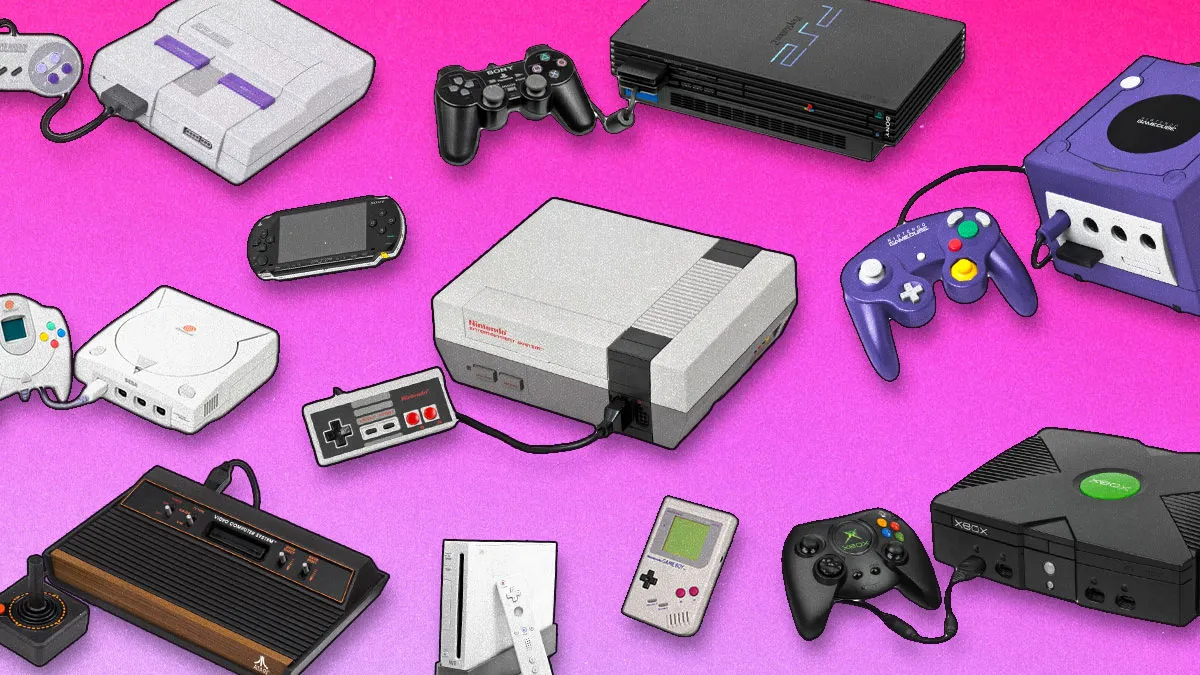
Every few years throughout the 1970s, 1980s, and 1990s, a new generation of gaming hardware arrived and changed what was possible. These weren't incremental improvements — each generation brought fundamentally new capabilities, new design philosophies, and new cultural moments. The story of console gaming is, in many ways, the story of what happens when technology accelerates faster than anyone expects.
Understanding console generations means understanding not just the hardware but the context around it: who was buying these machines, what they expected from them, and how the game-makers responded. Each generation had its own personality, its own landmark titles, and its own reasons for mattering.
First Generation: The Dawn (1972–1976)
The first dedicated home video game console was the Magnavox Odyssey, designed by Ralph Baer and released in 1972. It was a remarkable and strange device. The Odyssey had no microprocessor — it used analogue circuitry to generate simple dots of light on a television screen. Players would place plastic overlays directly onto their TV sets to create the illusion of different game environments.
The Odyssey came with twelve games, including a tennis game that Nolan Bushnell reportedly encountered before designing Pong. Magnavox sued Atari for patent infringement and eventually won, receiving royalties from almost every major video game manufacturer of the era.
The first generation also included early Atari home products and a range of Pong clone systems. By modern standards, these devices could do almost nothing — but they established the fundamental concept of a machine connected to your television, designed for interactive play.
Second Generation: The Cartridge Revolution (1976–1992)
The second generation brought the microprocessor and, crucially, the interchangeable cartridge. The Fairchild Channel F (1976) was the first cartridge-based console, but it was the Atari 2600 (1977) that defined this generation and brought gaming into millions of homes.
The 2600's design was brilliantly pragmatic. Its 6507 processor ran at just over 1 MHz and had only 128 bytes of RAM, but clever programming could extract remarkable results. Games like Adventure (1980) offered exploring multiple screens and collecting objects — early steps towards what would become the action-adventure genre.
The Atari 5200 (1982), Mattel's Intellivision (1979), and Coleco's ColecoVision (1982) competed for market share during this period, each offering superior hardware to the aging 2600. The ColecoVision in particular offered near-arcade-quality graphics for its time and came bundled with Donkey Kong.
This generation ended messily with the great crash of 1983, caused by market saturation, poor quality control, and consumer confusion — but the concept it established, of a cartridge-based platform supporting a software library, became the template for every generation that followed.
Third Generation: Nintendo's Dominance (1983–1992)
The third generation is defined almost entirely by Nintendo. The Famicom, released in Japan in 1983 and exported to North America as the Nintendo Entertainment System (NES) in 1985, was a technically capable machine with an exceptional software library and, crucially, strict quality control. Every game on the NES had to pass Nintendo's approval process — the first publisher certification system in the industry.
The NES's library was extraordinary. Super Mario Bros. (1985) established the side-scrolling platformer as a genre and remains one of the most influential games ever made. The Legend of Zelda (1986) pioneered battery-backed saves and open-world exploration. Metroid (1986) introduced atmospheric isolation and non-linear progression. Mega Man (1987) perfected the pattern-based action platformer. These weren't just good games — they were defining statements about what interactive entertainment could be.
Sega's Master System launched in the West in 1986 and offered comparable hardware but never matched Nintendo's software quality or market share. By the end of this generation, the NES had sold over 61 million units worldwide.
Fourth Generation: The Console Wars Begin (1987–1996)
The fourth generation introduced 16-bit processors and, with them, a level of graphical and audio fidelity that genuinely stunned players. It also introduced the concept of a genuine console war — a direct marketing battle between two competing platforms for the same audience.
Sega launched the Mega Drive in Japan in 1988 (arriving in Europe as the Mega Drive in 1990) and positioned it aggressively against Nintendo's forthcoming SNES with the slogan "Genesis Does What Nintendon't." The Mega Drive launched Sonic the Hedgehog in 1991 — a character designed specifically to appeal to an older, cooler demographic than Nintendo's Mario.
Nintendo's Super Nintendo Entertainment System (SNES), released in Japan in 1990, was the more powerful machine overall, featuring the Mode 7 graphics engine that allowed for pseudo-3D scaling effects — most famously used in F-Zero and Super Mario Kart. The SNES library included some of the most beloved games ever made: Super Metroid, The Legend of Zelda: A Link to the Past, Chrono Trigger, and Final Fantasy VI among them.
The console war between Sega and Nintendo defined a generation of gaming culture. Schoolyard debates about which console was better were conducted with remarkable passion. Both platforms were genuinely excellent, but the competition between them drove innovation in ways that might not have happened otherwise.
Fifth Generation: The 3D Leap (1993–2002)
The shift from 2D to 3D graphics was the most dramatic single transition in gaming hardware history. The fifth generation had to solve entirely new technical and design problems — how do you control a character in three-dimensional space? How do you design levels that aren't flat? How do you make a camera that follows the player intelligently?
The Sony PlayStation, released in Japan in 1994, was the surprise entry that redefined the industry. Originally developed as a CD-ROM add-on for the SNES before the partnership with Nintendo collapsed, the PlayStation was a powerful machine that could render polygon-based 3D graphics smoothly and store data on inexpensive CDs rather than expensive cartridges. Its lower software manufacturing costs made it attractive to developers, and its library expanded rapidly.
Nintendo's Nintendo 64 (1996) remained committed to cartridges — a decision that limited storage capacity but eliminated load times. Super Mario 64, the N64's launch title, is arguably the most significant game of this generation: it defined how 3D platformers work, inventing camera control systems and movement mechanics that remain standard today.
Sega's Saturn and then Dreamcast also competed in this generation. The Dreamcast (1998) was technically impressive and pioneered online gaming with its built-in modem, but Sega's financial difficulties and the announcement of the PlayStation 2 effectively ended the Dreamcast's commercial life before it could reach its potential.
The Portable Revolution: Game Boy and Beyond
No discussion of console evolution would be complete without addressing Nintendo's handheld hardware. The Game Boy, designed by Gunpei Yokoi and released in 1989, used older technology than its competitors — monochrome screen, relatively low-powered processor — but its long battery life and robust, inexpensive construction made it extraordinarily successful.
Tetris, bundled with the Game Boy in most markets, was perfectly suited to portable play — short sessions, simple controls, genuinely compelling gameplay. The combination was unstoppable. The Game Boy sold over 118 million units across its lifetime (including the Game Boy Color and Pocket variants), making it one of the best-selling gaming devices of all time.
What Each Generation Left Behind
Looking back across the generations, what stands out is not just the increasing power of the hardware but the increasing ambition of what game designers tried to achieve. Each generation set a new ceiling for what games could express — emotionally, narratively, mechanically.
"Every console generation was a new argument about what games could be. And each time, the answer turned out to be: more than we imagined."
The first generation proved that interactive entertainment was commercially viable. The second generation put it in living rooms. The third generation gave it artistic credibility. The fourth generation gave it cultural battlegrounds. The fifth generation gave it a new dimension — literally.
The machines themselves — those plastic boxes with their particular button layouts, their distinctive startup screens and sounds — are now artefacts. They sit in collections and museums, displayed with the same care as industrial tools from previous eras. But unlike most tools, they still work exactly as intended. You can still pick up a SNES controller and play Super Mario World and feel precisely what players felt in 1991. That immediacy is one of the things that makes gaming history uniquely accessible: the past is still playable.
Understanding the evolution of consoles is ultimately about understanding the creative ambition that drove it — the designers and engineers who looked at each new generation of hardware and asked, "What can we make now that wasn't possible before?" The answer, generation after generation, was extraordinary.